
St. Cloud Area Schools
Referendum Campaign

In 2025, after multiple failed attempts, St. Cloud Area School District 742 secured strong voter approval for a two-question bond referendum designed to address critical safety needs and keep pace with modern workforce-readiness needs at Apollo High School. The district serves a diverse population of nearly 10,000 students covering 250 square miles and has two traditional high schools– Apollo High School, built in 1970, and Tech High School which opened in 2019.

Question one included a secure entrance, storm shelter, fire safety upgrades and upgraded Career and Technical Education (CTE) spaces including health sciences, emergency response, technology and culinary arts. Question two included more space for athletic and recreational activities, based on community feedback. 

This referendum followed a successful enrollment campaign that addressed years of declining enrollment and community misperceptions. We partnered with St. Cloud Area Schools on both projects, which led to a seamless transition, weaving key messages from the enrollment campaign into referendum messaging. Through the four-step process, R-PIE (Research, Planning, Implementation, Evaluation), we built on the enrollment campaign which reframed the narrative and rebuilt trust in the community. 

This campaign demonstrates how strategic communication, rooted in community engagement with a foundation of trust, can deliver measurable outcomes in complex and divided communities.

2026 Golden Achievement Award Badge

This campaign was recognized with a Golden Achievement Award from the National School Public Relations Association (NSPRA).

On the Ballot:

  • Question 1: $50 million to upgrade Apollo High School with a secure entrance, storm shelter, fire safety improvements and expanded career and technical education spaces
  • Question 2: $15 million to construct an indoor multipurpose athletic facility for students and the community
  • Total tax impact: $3.33 per month for the average $250,000 home

* Question 1 was required to pass for Question 2 to be approved

Our Approach

Research Icon

We drew much of our research from the enrollment campaign we just finished, including community dynamics and potential challenges. We researched the district’s referendum history and voter trends.

Plan Icon

We defined campaign objectives and identified voter turnout targets.


Our communications strategies maximized voter awareness and engagement, i
ncluding multilingual and equity strategies to engage all voters in the district.

Implement Icon

The campaign was implemented over a 16-week period following a phased approach. We used visual storytelling to communicate complex information, and district leaders held more than 90 in-person presentations.

Evaluate Icon

The special election produced strong results with anticipated low voter turnout, validating the messaging strategy and outreach plan.


Question 1 passed with
62.1% of the vote, and question 2 passed with 54.3%.

Key messaging framework

We identified key messages from the enrollment campaign that supported the referendum messaging:

  • “We are one district, bringing communities together to serve all students.”
  • “We offer a world of opportunities, empowering our students to create the future of their dreams.”

We wove these key messages into the referendum campaign for a seamless transition between the two campaigns.

Campaign Brand:
Building Brighter Futures: A Vision for Future-Ready Student Success
Campaign Logo: "Building Brighter Futures. Vote April 8"

Message Pillars:
Six Consistent pillars were used across communication materials. Each communication reinforced at least two pillars.

  1. Student & Staff Safety First
    Secure entrance, storm shelter, fire safety compliance.
  2. Preparing Students for the Future
    CTE upgrades in health sciences, emergency response, technology and culinary arts.
  3. Creating comparable learning experience at both high schools
    Tech High School shows what is possible with modern spaces for hands-on learning.
  4. Indoor Athletic Space for the Community
    Shared-use facility benefiting youth programs, public and private school students.
  5. Strong Schools = Strong Community
    Investing in schools strengthens neighborhoods and increases property values.
  6. Financially Responsible
    $3.33 per month impact for the average homeowner.

Messaging was pre-tested internally and refined for clarity and simplicity. During the planning phase, we started identifying key campaign visuals we would need to create or gather.
Tech High School Video

Planning ahead of this campaign’s implementation phase, we created a video to set the stage for the referendum request: a Tech High School video to show what state-of-the-art facilities, intentionally designed for career and technical education, made possible for students.

Referendum Video storytelling

We leaned into video storytelling as a key component of this campaign. In addition to the Tech High School video, we created a referendum overview video and five social cuts. We worked with district leaders to source submitted video for three videos focused on get-out-the-vote efforts, and added eye-catching, thematic graphics.

The overview video laid out the two-question request, referendum history, and current realities inside of Apollo High School. The social cuts strategically targeted campaign messaging in bite-sized videos. 

Click here to view the St. Cloud referendum playlist on YouTube

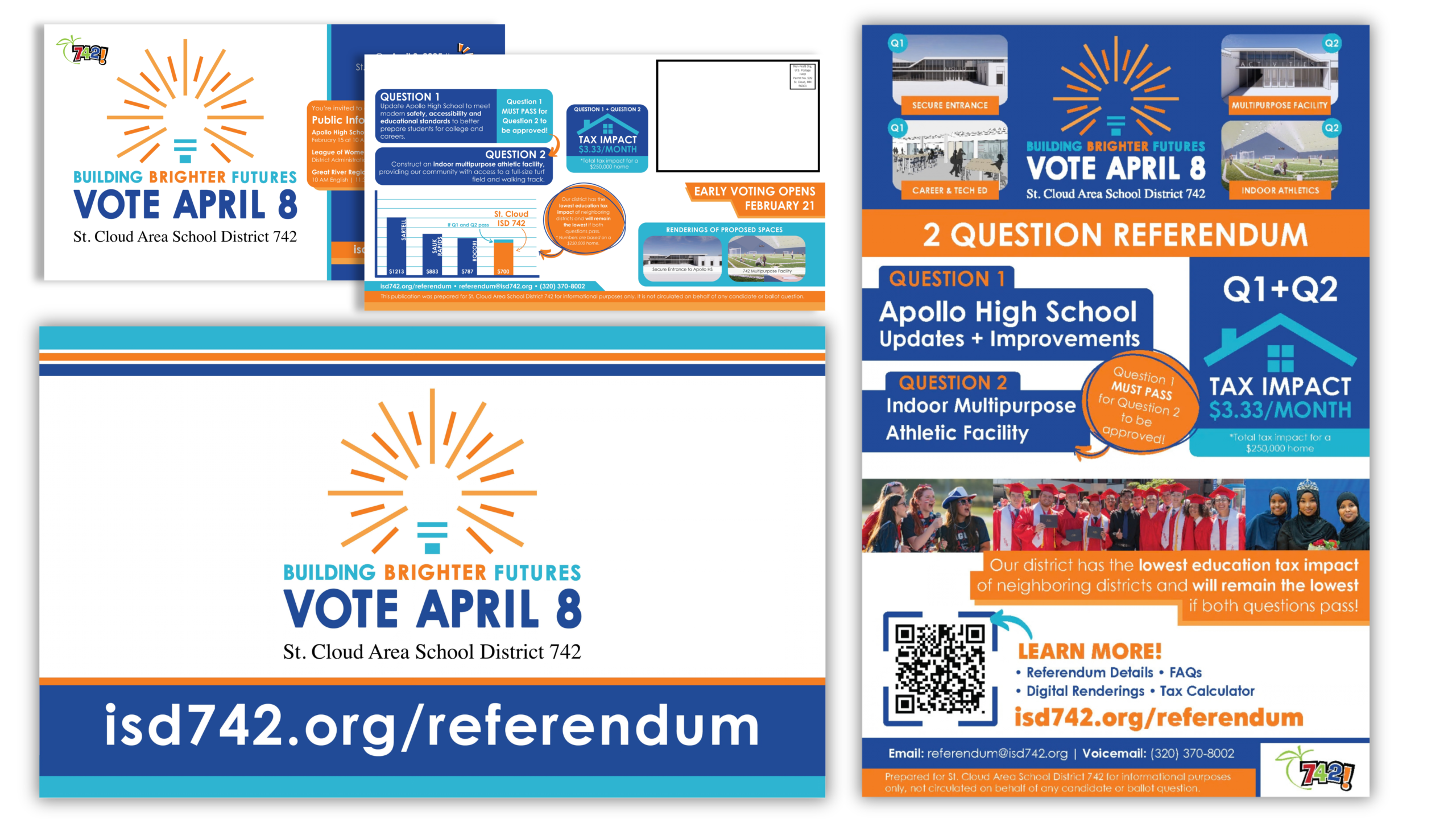
Collage of various St. Cloud referendum materials

printed materials
+ Digital signage

We created a variety of materials to reach voters in many different ways and quickly explain the referendum in a scannable format. These materials included a fast facts sheet, mailed post card, an outdoor banner to hang at district buildings, posters for each school entrance, a business card leave behind for door knocking, a-frame signs for drop off lines, slides for digital signage at school entrances, and more.
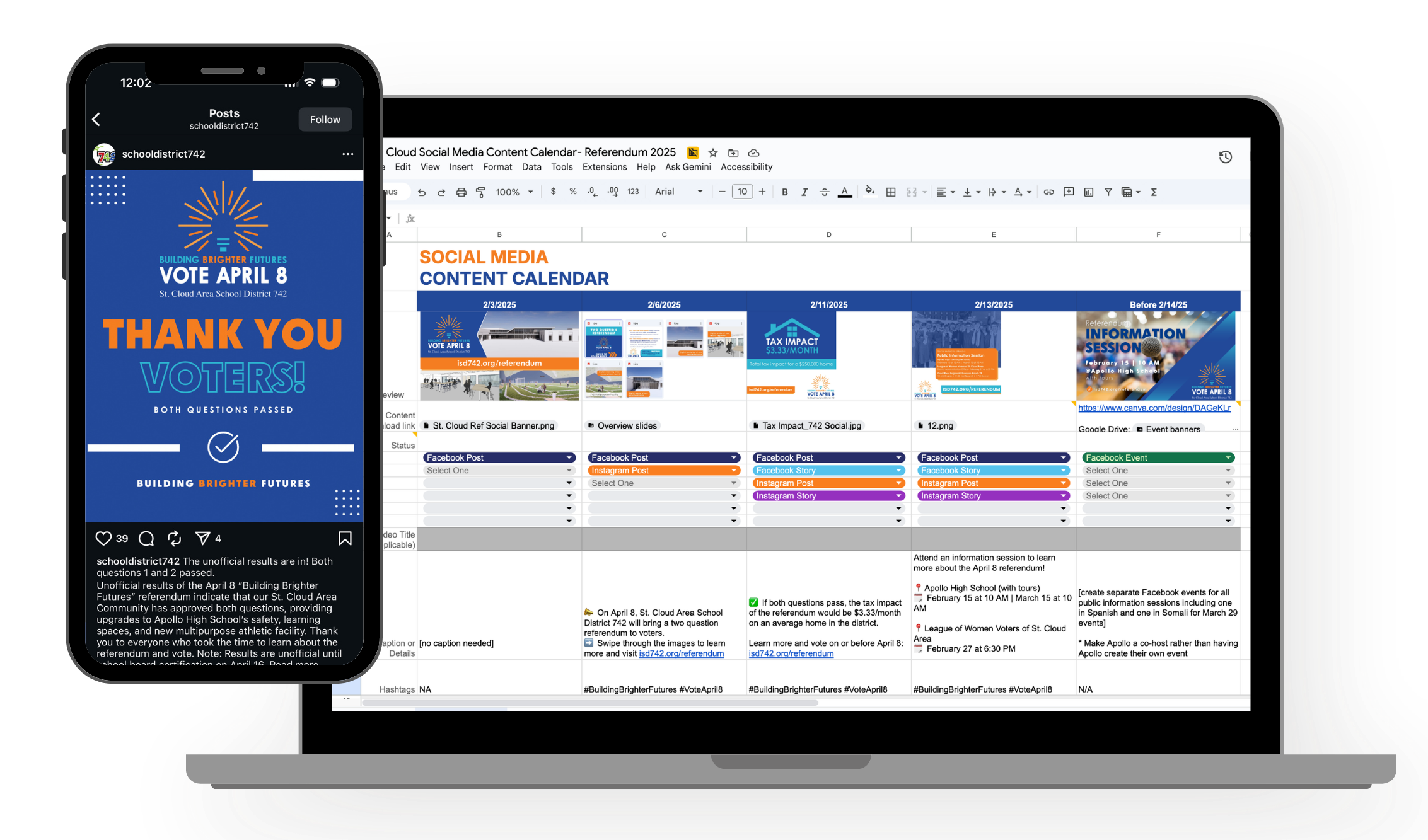
Laptop with social media content calendar next to a phone showing a "thank you voters" social media post

Social Media
content calendar

We created a social media content calendar with dates, captions, suggested platforms, and downloadable graphics. This made it easy to plan our social media strategy and send large quantities of content to the district for batch scheduling. We created voting countdown videos utilizing motion graphics, which were posted to the district's stories toward the end of the campaign.
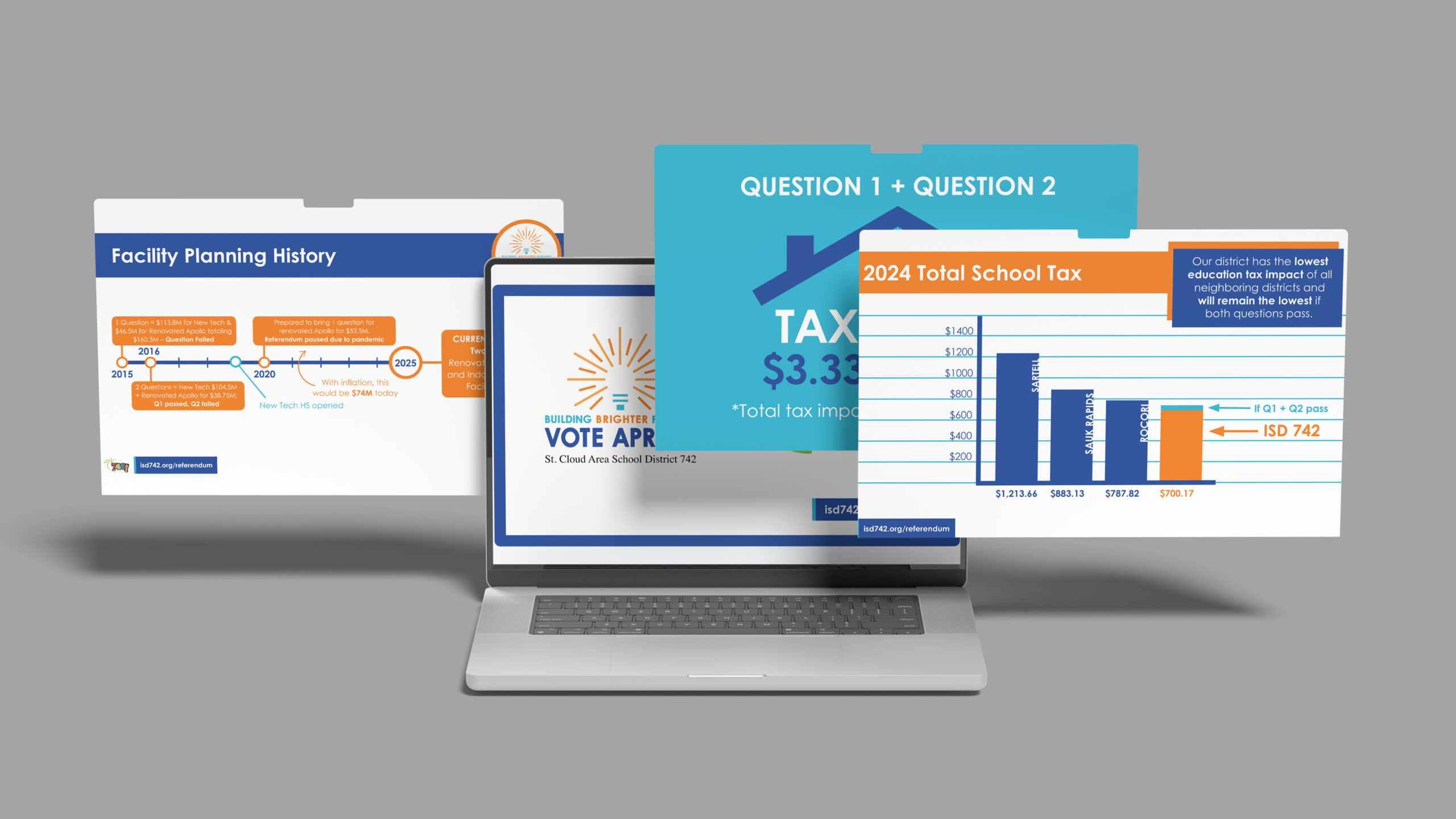
Slide deck mockup: St. Cloud referendum

Community
Engagement

We created a comprehensive slide deck explaining the referendum questions, referendum history, and tax rate comparisons to other districts. District leadership delivered the referendum message at more than 90 in-person community events. This was a key to informing and engaging voters, leading to the success of the campaign.
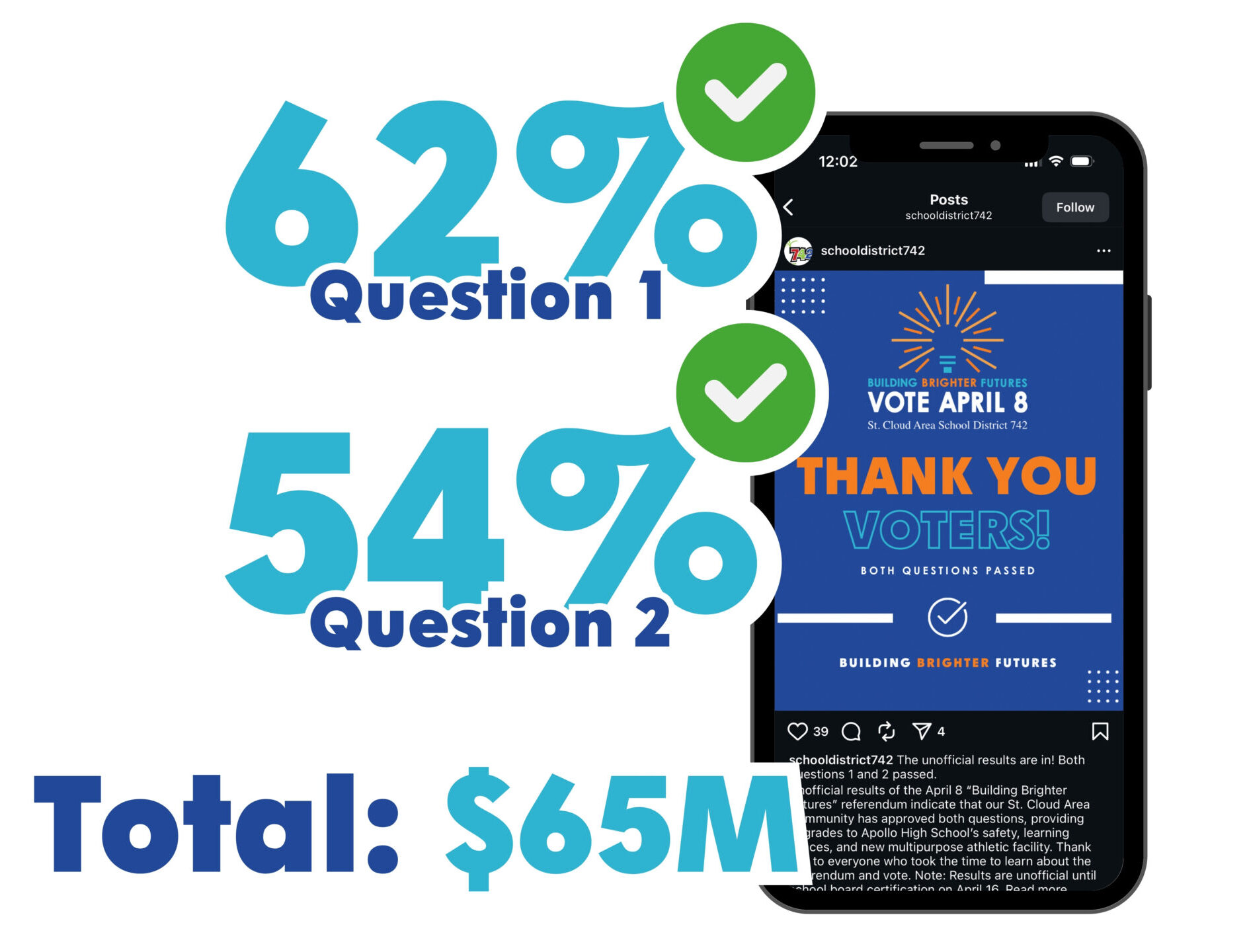
A mockup with a phone displaying a thank you voters post, alongside the percentages of support and the total of $65 million

Key Success Metrics

  • Strong Approval Rate: success. 62% voted yes on question one, which was a decisive victory after previous failed attempts.
  • Social Media Engagement: success. 40+ social media and website graphics generated strong interactions 117,000+ cumulative reach, 206,000+ views, and more than 3,000 reactions, comments, and shares. Viewers collectively watched more than 106 hours of campaign video content.
  • Community Engagement: success. Around 90 community meetings generated engagement, increased public trust, and contributed to a noticable narrative shift as noted by district leadership.
  • Effective Messaging: success. FAQs, presentations, and infographics addressed public concerns.
  • Voter turnout: moderate success. Voter turnout was lower than our target, but within the margin of expected voter turnout for off-cycle elections in Minnesota. The total votes cast reflect about 15-16% of registered voters in the district.

Explore more

Read the full NSPRA award submission for this campaign, or check out more strategic communications projects on our Case Studies page.